
Sometimes one needs to stand back to assess a market, especially under high volatility.
Depending on the area and time frame, some variables will affect value more than others. One particularly important variable is supply versus demand.
Rancho Santa Fe
Sometimes one needs to stand back to assess a market, especially under high volatility.
Depending on the area and time frame, some variables will affect value more than others. One particularly important variable is supply versus demand. We have seen this ratio vary amongst price tiers in many of the areas that we cover in this editorial, but we have never stood back and examined how this supply-demand 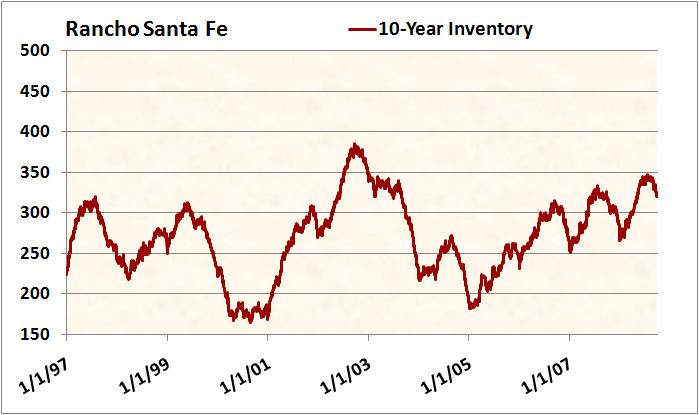 balance has trended historically by area. When we ran this analysis against Rancho Santa Fe, we discovered a historical imbalance.
Chart A shows average daily number of listed properties for sale from January 1997 – October 2008 for Rancho Santa Fe (defined for the purpose of this analysis as all attached and detached residential properties listed with the San Diego Multiple Listing Service for the 92067 and 92091zip codes). Interestingly, inventory levels over the last year or two, albeit climbing, have not exceeded the historical maximum. As a matter of fact, inventory levels grew faster and higher from 2001 – 2003, than they have over the last 4 years. From merely a supply perspective, Rancho Santa Fe is looking healthy.
However, as we all know, supply is only half the picture. When we take the average inventory and divide it by the number of properties sold we get Chart B. This shows how the supply/demand ratio has trended over the last 10 years. Essentially, this chart represents the history of how many properties were available for sale per property sold. This ratio has trended flat, for the most part, with some volatility. Except starting in 2005, 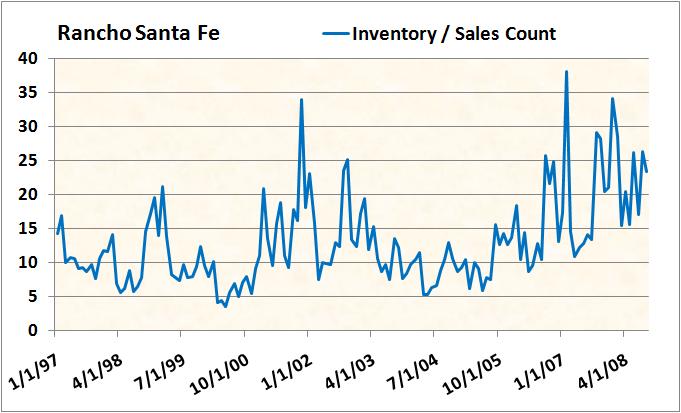 this ratio has been trending upwards, setting a new maximum, and new mean highs.
This has resulted primarily from the reduction in the number of properties sold. Overall, sales have dropped more than inventory has climbed, skewing the supply/demand ratio towards a buyer’s market, providing on average more potential properties per buyer. Not surprisingly, when more sellers compete for a buyer, price softening typically occurs…but not necessarily.
This apparent paradox is exhibited in Chart C which provides year-over-year variances for many Rancho Santa Fe parameters comparing the first 9 months of 2007 to the same period of 2008. As exhibited within the 10-year inventory chart, supply has been increasing over the last two years, but sales have been decreasing faster than supply has been growing, resulting in an upward trending supply/demand ratio 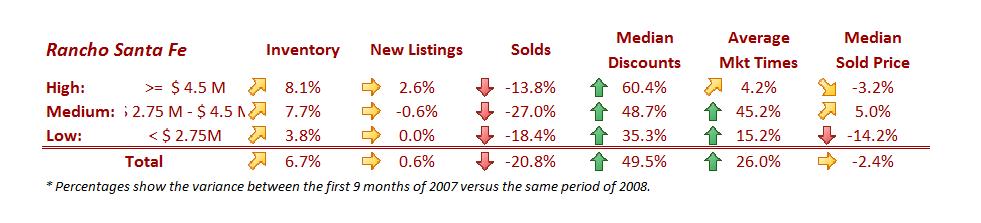 across all three price tiers. Consequently, one would expect price declines in all three price segments as well, but the middle tier (properties with an original listing price between $2.75M – $4.5M) has actually shown a median price increase of 5.0%, even though it had the largest percentage decline of its number of properties sold.
Creating this paradox is marketing time. Even though buyers in this price tier have had more properties to choose from, sellers have been holding out for their price, driving marketing times up almost 50% and driving sales down. This dynamic represents sellers that are in no rush to sell and thus maintaining price level. The problem is that this is a short-run tactic. At some point, marketing times get extended to unrealistic durations and number of sold properties shrinks to levels that cannot accommodate normal migration. Going forward an important bottoming precursor will be supply/demand trends juxtaposed to marketing timelines for area subpopulations.
Del Mar
Similarly to Rancho Santa Fe, Del Mar (defined for the purpose of this analysis as all attached and detached residential properties listed with the San Diego Multiple Listing Service for the 92014 zip codes) has experienced declines in the number of properties sold. One cannot help but consider how this affects Del Mar’s real estate market. As we showed for Rancho Santa Fe, declines alone in the number of properties sold does not necessarily mean value decline. There are more variables involved than a simple one-to-one relationship.
A better indicator is to look at Del Mar’s historical supply/demand ratio. If we let the number of properties available for sale represent supply (or inventory) and the number of properties sold represent demand, then we can examine how this ratio of supply-over-demand has trended historically. This ratio essentially represents the number of properties available for sale per property sold. A lower ratio favors sellers; a higher ratio, buyers. Obviously, as this ratio increases, buyers have more to choose from. This larger inventory increases a buyer’s probability of purchasing an undervalued property (or getting a “steal”) and thus lowering current comparables, potentially creating a cycling down valuation dynamic.
To create this historical supply/demand trend, we calculated Del Mar’s historical inventory from January 1997 – October 2008 (Chart D). Like Rancho Santa Fe, average daily inventory began climbing in the 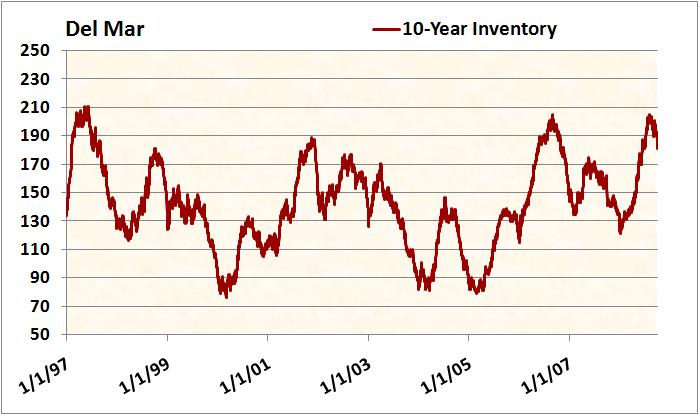 beginning of 2005. During that ascent there has been dips; nevertheless, the general path has been upwards, ever since. Twice inventory levels reached historical highs set back in 1997 (coincidentally, near San Diego’s last real estate bottom), approaching a daily average of 210 properties available for sale. However, since 2005, inventory levels have not broken out to set new historical inventory records. Yet, Del Mar does seem to be testing the 210 inventory mark.
This is not the case for number of properties sold. Declines there have created significantly new lows. When we take historical inventory levels and divide them by the number of properties sold, we get supply-over-demand, as shown in Chart E. Here we see the same pattern exhibited in Rancho Santa Fe. The ratio has been steadily rising ever since 2005, creating new highs. At the beginning of that period, we see for every 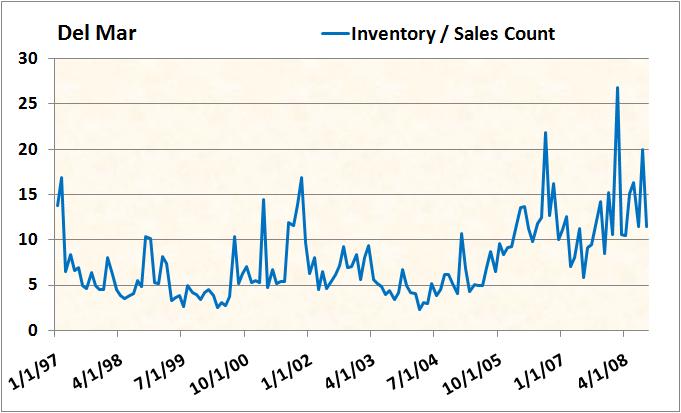 property sold that there were between 5 – 10 properties available for sale. That has increased to nearly 25 properties available for sale per every property sold.
Does this mean prices can be expected to dramatically decline in Del Mar? Not necessarily. Not all areas behave similarly to increasing supply/demand ratios. One important consideration being: Do sellers have to sell? High-end areas like Del Mar, tend to have lower loan-to-value ratios, lower debt-to-income ratios…variables that create greater financial wherewithal on the part of the seller. However, these factors do not create complete immunity against supply versus demand.
As we saw in Rancho Santa Fe, higher-end sellers can hold out for price longer than most, even under excess supply conditions. But also, like we mentioned for Rancho Santa Fe, that only works for so long, if supply continues to outstrip demand. For example, Del Mar’s high-end inventory, properties with an original listing price greater than $2 million, has nearly doubled from January 2008 to October 2008. So, despite sellers increasing their marketing times by 40% more than last year, median prices have declined more than any other price tier in Del Mar (Chart F). Consequently, while it is important to look at a community’s overall 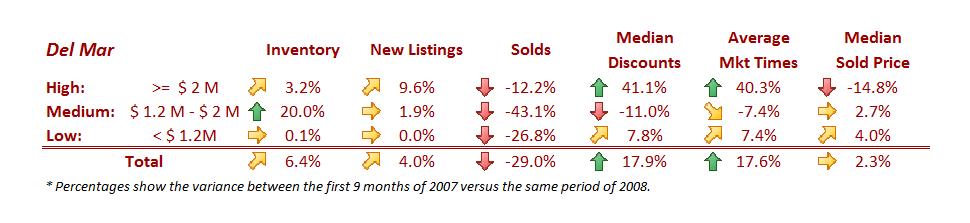 supply/demand changes, one must remember that each price tier within that community has its own supply/demand balance. It is just as important to look at that subpopulation’s supply/demand history and how long it has been wrestling with an imbalance.
What’s next?
When reviewing the data that we put together for Rancho Santa Fe and Del Mar, it is important to remember that these areas are comprised of sub-populations, some behaving much differently than others. For example, properties in Del Mar that are on the beach behave differently than some other areas of Del Mar. Likewise, horse property in Rancho Santa Fe behaves differently than some other types of properties in Rancho Santa Fe. What we have presented here is a total snapshot that blends these sub-populations together for the individual areas. We have also integrated the data to explain the individual real estate markets. In next month’s edition, we’ll examine La Jolla and Solana Beach/Encinitas.
Written by Linda and Tom Sansone
Willis Allen Real Estate
www.LindaSansone.com
Phone (858) 775-6356